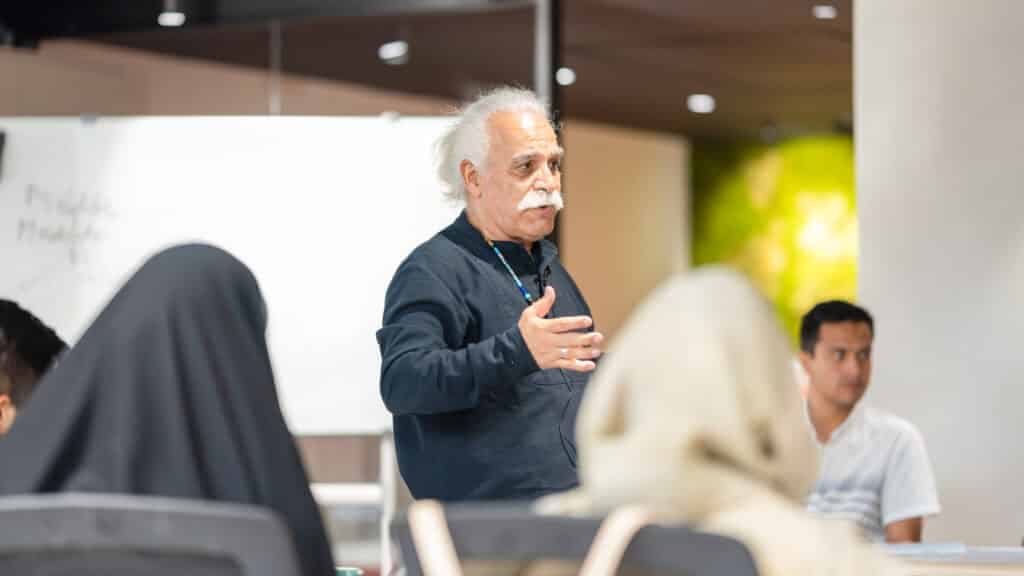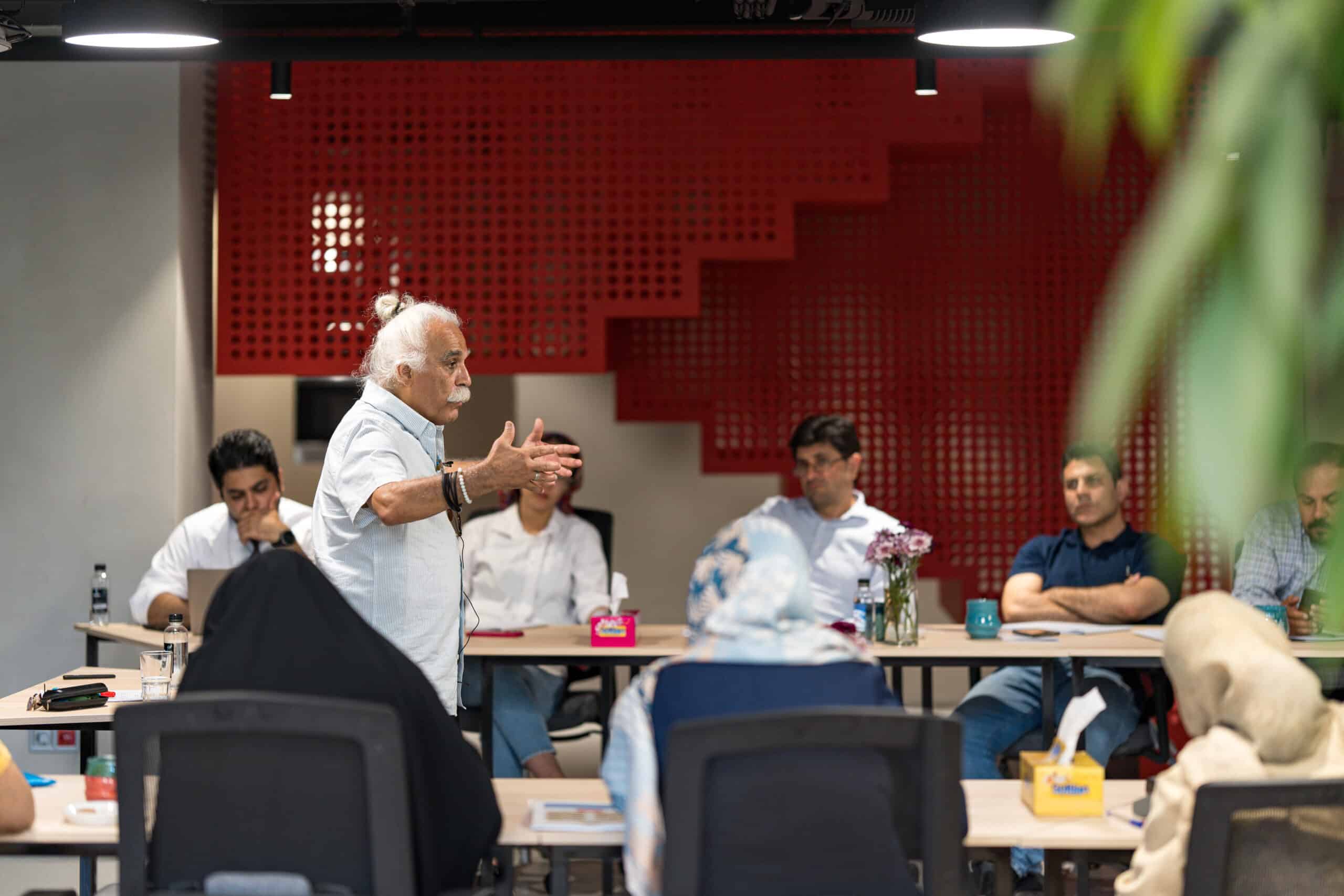
Faraatar successfully completed its first Foundations of Miandari course. Directed by Dr Ahmad Aminian, with leading instructors in psychology, sociology, law, art and communication, the course ran from 12 Ordibehesht to 16 Tir in the Solar Hijri calendar.

Held for the first time in Iran, the course introduced the foundations, core concepts and techniques of Miandari. Participants explored practical approaches across several fields, drawing on the knowledge and experience of Sara Karimi in sociology, Hiva Pegahan in art, Afsaneh Khalili in communication, Zahra Najafi in psychology and Dr Mohammad Amir Ghodousi in law. Those who completed the course received a certificate from Otagh Farhang va Honar-e Orupa, based in Brussels, Belgium, recognising their commitment to learning Miandari skills. At the end of the course, participants also received a commemorative badge designed by Dr Ali Asali, an artist, art-history researcher and graphic designer.

What is Miandari?
A fundamental aim of a citizen-led society is coexistence without destructive, violence-provoking conflict. Methods of reducing tension and resolving individual and group differences, while protecting personal interests and social solidarity, are therefore increasingly relevant across modern life. In societies seeking to manage interpersonal and social tensions responsibly, Miandari and communication have particular significance. As a dynamic process, Miandari enables different values and perspectives to enter dialogue and recognise one another without fear. Within a climate of trust, difficult and tense situations can move towards a calmer, more understandable and better future.

Why Miandari training matters today
Foundational Miandari training introduces its theoretical and practical principles in today’s world, with attention to national and international cultures of nonviolence and tension reduction. It is useful for anyone seeking thoughtful, creative ways to address conflict through research and individual or social action.
Miandari originated within the broader concept of mediation but has gradually developed into an independent concept. This voluntary process allows people experiencing tension, difference or disagreement to find shared solutions with a Miandar’s support. The Miandar must remain independent of official institutions, authority and claims to superior insight, and practise without taking sides or imposing a judgement.
Miandari training introduces fundamental concepts, current knowledge and practical applications. Participants can use it to manage tensions in social, family, cultural, civic, educational, communication, economic and business relationships.

Meet the course instructors
Ahmad Aminian
A historian of ideas and philosophy, specialist in Indian and Iranian studies, and practitioner of nonviolent communication. He has worked as a professional Miandar in Brussels since 1995 and as a research collaborator at the University of Brussels, within philosophy, sociology and the study of religious and nonreligious ideas. His teaching includes cultural dialogue, tension reduction, intercultural educational philosophy, educational Miandari, social and family Miandari, and the philosophy and practice of Miandari in social and cultural conflicts. He has also taught cultural Miandari and dialogue between civilisations in Mali, Morocco and Algeria, drawing on philosophy and art.

Hiva Pegahan
A graduate in visual arts, performing arts and music, with a Brussels certificate in artistic and social Miandari. She designed and founded the Joy project, involving Miandari activities with working children and socially vulnerable families. Her work includes street-based and ecological artistic Miandari and intercultural and interethnic Miandari.
Sara Karimi
She holds a bachelor’s degree in communication from Allameh Tabataba’i University and a master’s degree in social planning and policy from the University of Tehran. An independent researcher and teacher of philosophy, sociology and history, she has written several books on social and cultural issues in Iran.
Mohammad Amir Ghodousi
A researcher in the philosophy of law, moral philosophy and political philosophy, with a doctorate in public law from Shahid Beheshti University. He is a licensed attorney and university lecturer, and the author of several books on governance and tolerance.
Afsaneh Khalili
A journalism graduate of Allameh Tabataba’i University, lecturer at Daneshkadeh Khabar and Soore University, member of the specialist television directing committee, practising journalist and doctoral student in media management.